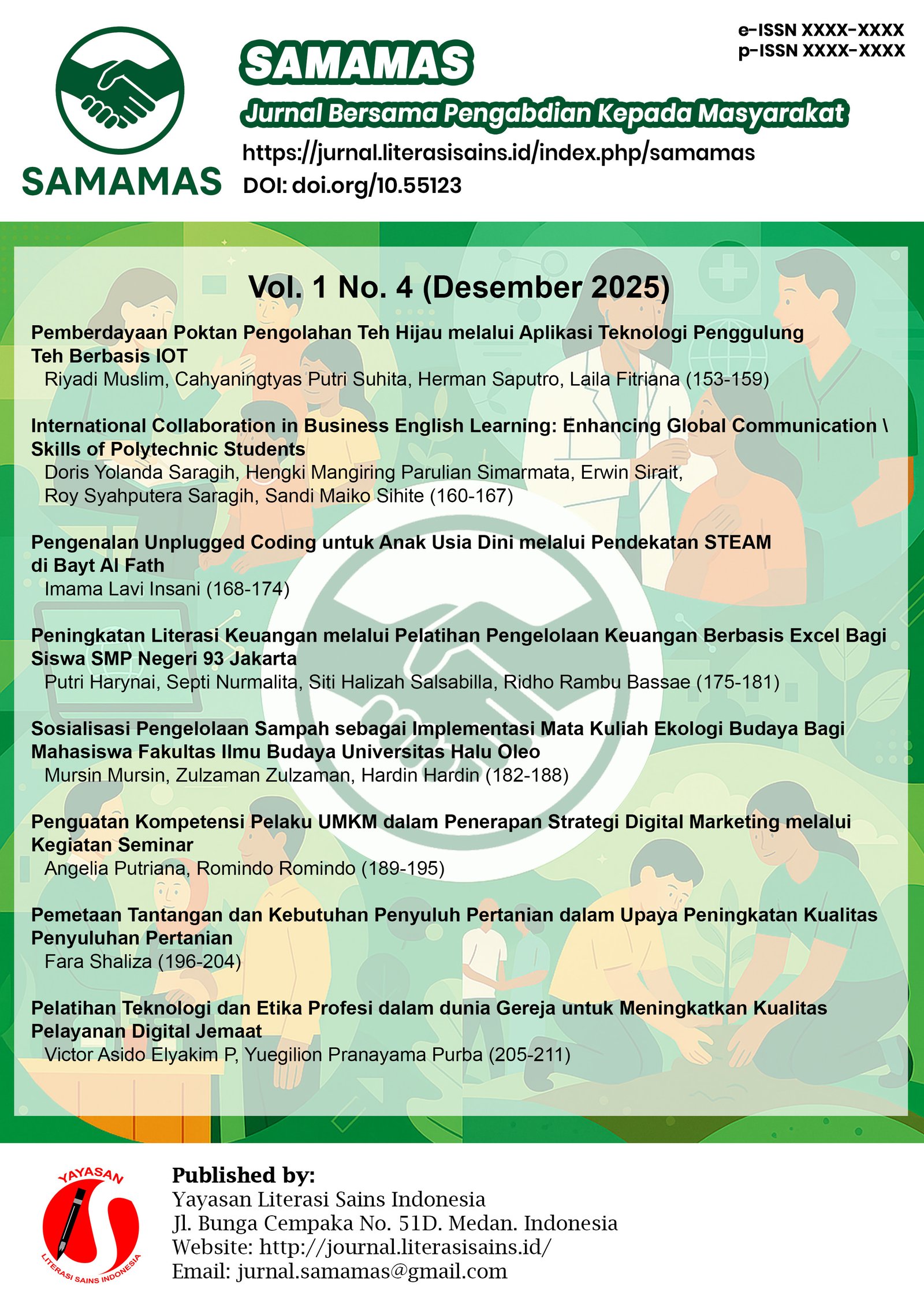
Sosialisasi Pengelolaan Sampah sebagai Implementasi Mata Kuliah Ekologi Budaya Bagi Mahasiswa Fakultas Ilmu Budaya Universitas Halu Oleo
DOI:
https://doi.org/10.55123/samamas.v1i4.394Keywords:
Socialization, Waste, EcologyAbstract
Waste management socialization is one form of implementing the Ecology course learning that aims to connect students' theoretical understanding with real practice in the community. This activity is carried out in response to increasing environmental problems due to the continuously growing volume of waste and the community's limited knowledge about sustainable management patterns. Through the socialization program, students apply ecological concepts such as material recycling, sustainability principles, the interrelationship of organisms with their environment, and the impact of human activities on ecosystems. The socialization is conducted using interactive lectures, group discussions, demonstrations of separating organic and inorganic waste, and simple compost-making practices. This participatory approach is designed so that the community not only understands the theory but is also able to practice it in daily life. The results of the activities show an increase in public knowledge and awareness about the importance of waste management from the source, including efforts to reduce single-use plastic, implement household waste sorting, and process organic waste into compost. In addition, these activities help build collective motivation to maintain environmental cleanliness, create healthier living spaces, and support the development of environmentally friendly behaviors. For students, these activities provide hands-on experience in applying ecological theory while enhancing communication, collaboration, and environmental analysis skills. Thus, waste management socialization not only contributes positively to the community but also strengthens the quality of ecological education as a relevant and practical science in addressing contemporary environmental issues.
Downloads
References
BPBD Kota Kendari. (2022). Laporan tahunan penanganan banjir Kota Kendari. Badan Penanggulangan Bencana Daerah Kota Kendari.
Dinas Lingkungan Hidup Kota Kendari. (2023). Statistik Pengelolaan Sampah Perkotaan Kota Kendari Tahun 2023. Kendari: DLH Kota Kendari.
Harahap, S. (2020). Pengaruh kesadaran masyarakat terhadap pengelolaan sampah rumah tangga. Jurnal Lingkungan dan Sosial, 5(2), 115–122.
Haryanto, B. (2019). Budaya lingkungan dan perilaku masyarakat dalam menjaga kebersihan. Jurnal Ekologi Manusia, 4(1), 45–52.
Kementerian Kesehatan Republik Indonesia. (2023). Profil kesehatan lingkungan dan risiko penyakit berbasis lingkungan. Jakarta: Kemenkes RI.
Noer, M. (2022). Analisis perilaku masyarakat terhadap pengelolaan sampah domestik di kawasan mahasiswa. Jurnal Pengelolaan Lingkungan, 7(3), 210–218.
Nursyamsi, R. (2022). Ketersediaan sarana pengelolaan sampah dan dampaknya terhadap kebersihan lingkungan. Jurnal Tata Kelola Lingkungan, 6(1), 33–41.
Riswani, T. (2021). Dampak penumpukan sampah terhadap mikroflora lingkungan. Jurnal Biologi dan Lingkungan, 9(2), 130–138.
Steward, J. (1955). Theory of Cultural Ecology. Urbana: University of Illinois Press.
Suparman, H. (2023). Pergeseran budaya gotong royong dalam konteks urbanisasi. Jurnal Antropologi Sosial dan Budaya, 10(1), 77–85.
WHO. (2024). Environmental health risks from unmanaged waste. Geneva: World Health Organization.
Downloads
Published
How to Cite
Issue
Section
License
Copyright (c) 2025 Mursin Mursin, Zulzaman Zulzaman, Hardin Hardin

This work is licensed under a Creative Commons Attribution-ShareAlike 4.0 International License.
Authors who publish with this journal agree to the following terms:
- Authors retain copyright and grant the journal right of first publication with the work simultaneously licensed under Creative Commons Attribution-ShareAlike 4.0 International License that allows others to share the work with an acknowledgment of the work's authorship and initial publication in this journal.
- Authors are able to enter into separate, additional contractual arrangements for the non-exclusive distribution of the journal's published version of the work (e.g., post it to an institutional repository or publish it in a book), with an acknowledgment of its initial publication in this journal.
- Authors are permitted and encouraged to post their work online (e.g., in institutional repositories or on their website) prior to and during the submission process, as it can lead to productive exchanges, as well as earlier and greater citation of published work (Refer to The Effect of Open Access).