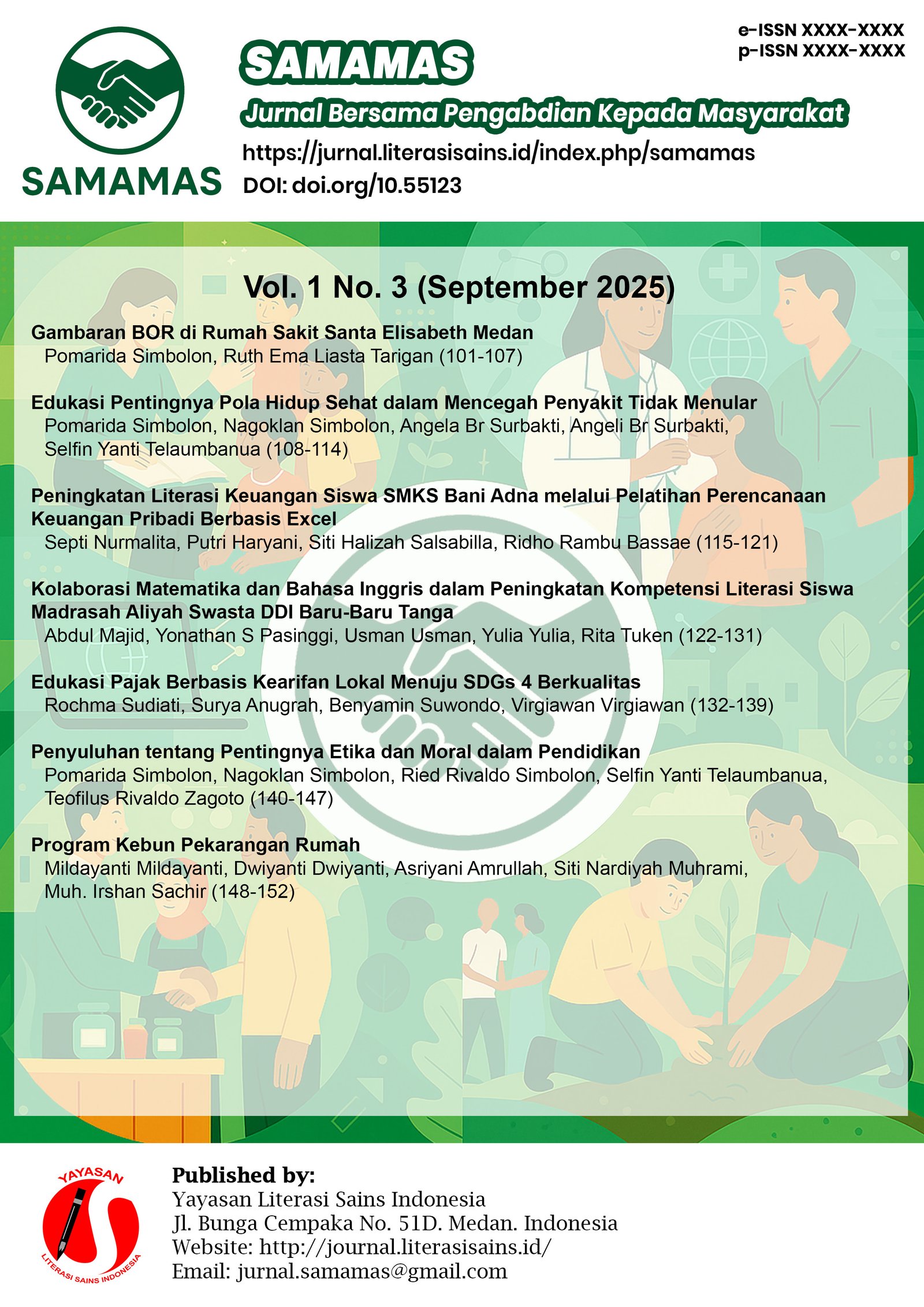
Edukasi Pentingnya Pola Hidup Sehat dalam Mencegah Penyakit Tidak Menular
DOI:
https://doi.org/10.55123/samamas.v1i3.303Keywords:
Education , Healthy Lifestyle , Non-Communicable DiseasesAbstract
Non-communicable diseases (NCDs) are a major health problem causing high mortality rates globally, particularly in developing countries, including Indonesia. The main causes of NCDs are closely related to unhealthy lifestyles such as lack of physical activity, poor diet, and smoking. According to WHO data, NCDs account for 74% of all global deaths, with 17 million deaths occurring before the age of 70. In Indonesia, the prevalence of NCDs continues to increase based on the results of the 2013 and 2018 Basic Health Research (Riskesdas). One strategic approach to reducing the risk of NCDs is through health education to encourage behavioral changes towards a healthy lifestyle. This Community Service (PKM) activity aims to increase the knowledge of students of the Health Information Management Study Program at STIKes Santa Elisabeth Medan about the importance of a healthy lifestyle in preventing NCDs. The implementation method included preparation, education using lectures and discussions, and pre- and post-test evaluations. Results showed a significant increase in participants' knowledge after the education. This improvement aligns with several previous studies demonstrating that health education can increase knowledge and encourage the adoption of healthy lifestyle behaviors. Health education has proven effective as an intervention in preventing NCDs among university students. The results showed a difference in average knowledge scores before and after the health education. The conclusion of this health education activity was that the knowledge of MIK students at STIKes Santa Elisabeth Medan increased by 30.87 points. It is hoped that this increased knowledge will lead to changes in student behavior, particularly regarding adopting a healthy lifestyle.
Downloads
References
Ayyasy, H. Y. (2021). Kata kunci و. Kinabalu, 11(2), 50–57.
Fabanyo, R. A., & Anggreini, Y. S. (2022). Teori Dan Aplikasi Promosi Kesehatan Dalam Lingkup Keperawatan Komunitas. Penerbit Nem. Https://Books.Google.Co.Id/Books?Id=6hedeaaaqbaj&Newbks=0&Prin tsec=Frontcover&Pg=Pr2&Dq=Rizqi+Alvian+Fabanyo&Hl=Id&Source=Ne wbks_Fb&Redir_Esc=Y#V=Onepage&Q=Rizqi Alvian Fabanyo&F=False
Irianto, Kus. 2004. Gizi dan Pola Hidup Sehat. Bandung: CV. Yrama Widya.
Indra, K. S. I. K., Nurhasanah, D., & Andriani, Y. (2023). Penyuluhan Terkait Penyakit Tidak Menular di LPK Cempaka Bantul. Journal of Innovation in Community Empowerment, 5(1), 28–31. https://doi.org/10.30989/jice.v5i1.840
Kartika, J., Sari, S. N., Rahma Sari, I. P., Romadhona, S. B., & Putri, N. C. M. (2024). Edukasi Pentingnya Pencegahan Penyakit Tidak Menular (Ptm) Pada Siswa-Siswi Man 1 Muara Enim. Jurnal Ilmu Keperawatan Dan Kebidanan, 15(1), 87–93. https://doi.org/10.26751/jikk.v15i1.2183
Kemenkes RI. (2022). Profil Kesehatan Indonesia Tahun 2021.
Notoatmodjo S (2010). Metodologi Penelitian Kesehatan. Jakarta : Rineka Cipta
Nurdianto, A. R., Anhar, C. A., Anwari, F., Charisma, A. M., & Farida, E. A. (2021). Edukasi Pola Hidup Sehat dalam Mengontrol Kadar Glukosa Darah Puasa bagi Anggota Prolanis Puskesmas Trosobo, Sidoarjo saat Pandemi COVID – 19. Prosiding Seminar Nasional Pengabdian Masyarakat Universitas Ma Chung, 1, 387–399. https://doi.org/10.33479/senampengmas.2021.1.1.387-399
Parlaungan, J., Fabanyo, R. A., & Mustamu, A. C. (2024). Edukasi Cerdik sebagai upaya Pencegahan Penyakit Tidak Menular Pada Masyarakat Klasaman Kota Sorong. Jurnal Kreativitas Pengabdian Kepada Masyarakat (PKM), 7(10), 4560–4575. https://doi.org/10.33024/jkpm.v7i10.16911
Poppen, Jerry, D. 2002. 41 Games for Elementary Physical Education Program. USA: Parker Publishing Company.
Who. (2023). Non Communicable Disease. World Health Organization.
Wiguna, I. N. A. P., Diaris, N. M., Suputra, I. K. D., Dewi, N. M. U. K., Apsari, D. P., Sinarsih, N. K., Kartika, I. G. A. A., & Juniartha, M. G. (2024). Edukasi Perilaku CERDIK Sebagai Upaya Pencegahan Dini Penyakit Tidak Menular. Sevanam: Jurnal Pengabdian Masyarakat, 3(1), 98–110. https://doi.org/10.25078/sevanam.v3i1.3596
Wiranta, A. P., & Roepajadi, J. (2019). Perbandingan Tingkat Kebugaran Mahasiswa Prodi Ilmu Keolahragaan Universitas Negeri Surabaya Berdasarkan Penggunaan Waktu Luang. Jurnal Kesehatan Olahraga, 07(02), 514–519. https://ejournal.unesa.ac.id/index.php/jurnal-kesehatan-olahraga/article/view/30076
Yarmaliza, Y., & Zakiyuddin, Z. (2019). Pencegahan Dini terhadap penyakit tidak menular (Ptm) melalui germas. Jurnal Pengabdian Masyarakat Multidisiplin, 2(3), 168-175. https://doi.org/10.36341/jpm.v2i3.794
Direktorat Pengendalian Penyakit Tidak Menular. PTM pencegahan pengendalian penyakit tidak menular di indonesia [Internet]. Kementrian Kesehatan Republik Indonesia. 2016:1–10. Diakses pada 24 Desember 2022
Downloads
Published
How to Cite
Issue
Section
License
Copyright (c) 2025 Jurnal Bersama Pengabdian Kepada Masyarakat (SAMAMAS)

This work is licensed under a Creative Commons Attribution-ShareAlike 4.0 International License.
Authors who publish with this journal agree to the following terms:
- Authors retain copyright and grant the journal right of first publication with the work simultaneously licensed under Creative Commons Attribution-ShareAlike 4.0 International License that allows others to share the work with an acknowledgment of the work's authorship and initial publication in this journal.
- Authors are able to enter into separate, additional contractual arrangements for the non-exclusive distribution of the journal's published version of the work (e.g., post it to an institutional repository or publish it in a book), with an acknowledgment of its initial publication in this journal.
- Authors are permitted and encouraged to post their work online (e.g., in institutional repositories or on their website) prior to and during the submission process, as it can lead to productive exchanges, as well as earlier and greater citation of published work (Refer to The Effect of Open Access).