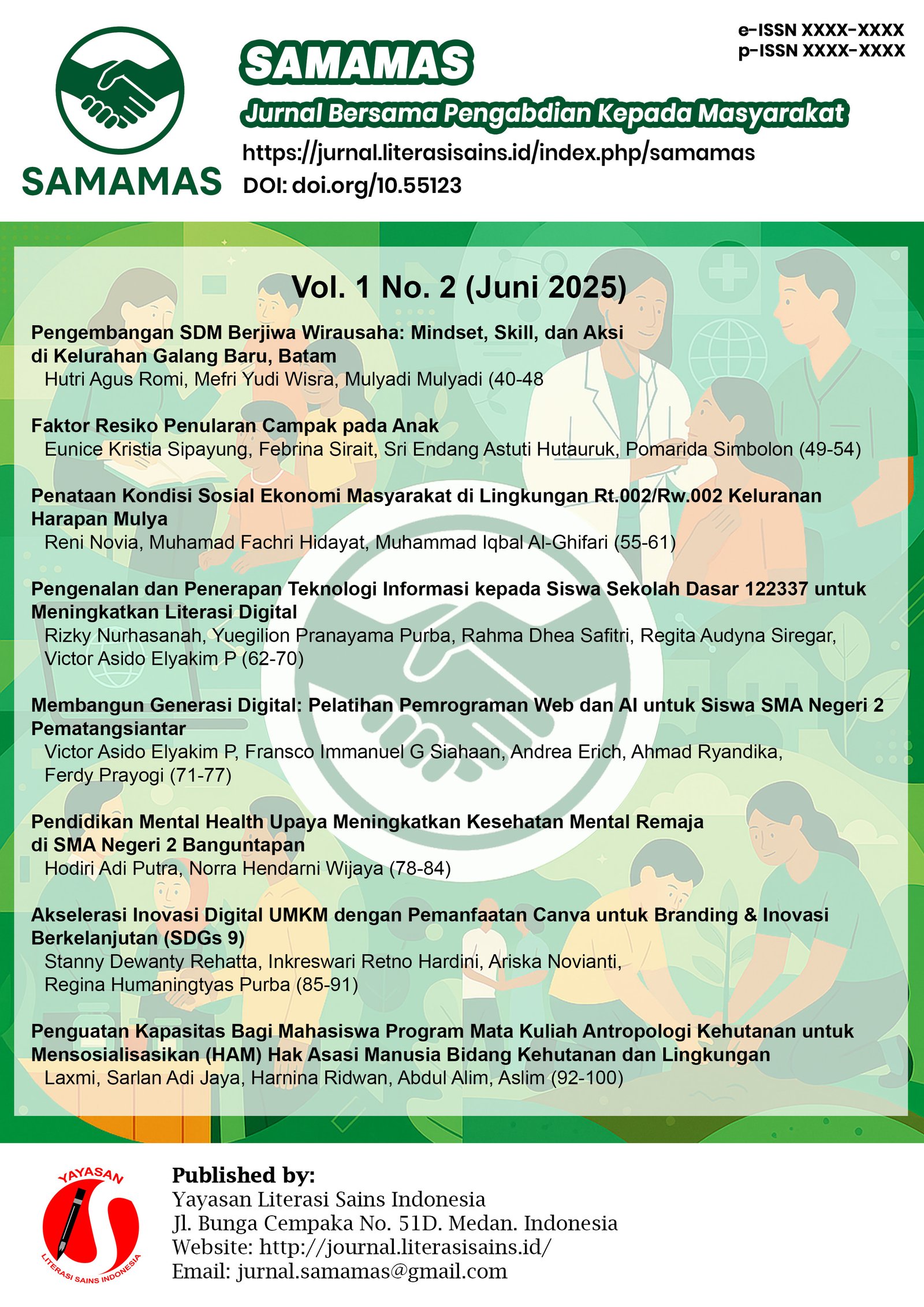
Membangun Generasi Digital: Pelatihan Pemrograman Web dan AI untuk Siswa SMA Negeri 2 Pematangsiantar
DOI:
https://doi.org/10.55123/samamas.v1i2.274Keywords:
Community Service , Web Programming , HTML , CSS , JavaScriptAbstract
This activity is part of the Community Service Program aimed at introducing the basics of web programming to students of SMA Negeri 2 Pematangsiantar. The program was initiated due to the limited access and knowledge of students regarding web development technology, despite the high demand for such competencies in facing digital transformation across various sectors. The material was delivered interactively through lectures, live coding demonstrations, open discussions, and simple case studies. Topics covered include the basic structure of web development such as Frontend, Backend, and Databeses as well as three main technologies: HTML, CSS, and JavaScript. The activity was designed not only to help students understand the theoretical concepts but also to allow them to see practical implementations firsthand. Evaluation was conducted through observation of student participation and discussions, which indicated that the students were very enthusiastic, actively asked questions, and some were even interested in continuing to learn independently. These results demonstrate that this Program activity is effective in improving digital literacy and increasing student interest in web programming. It is hoped that similar activities can be conducted continuously to faster a generation ready to face future technological challenges
Downloads
References
Adolph, S. (2016). The Power of Visual Learning in Computer Programming Education. Journal of Interactive Learning Research, 27(3), 235-252.
Ananda, P. L., Wardhani, N. I., & Nurhayati, E. (2024). Kohesi : Jurnal Multidisiplin Saintek Volume 5 No 9 Tahun 2024 PEMANFAATAN BAHASA PEMOGRAMAN WEB UNTUK MENINGKATKAN PEMAHAMAN TEKNOLOGI INFORMASI : STUDI KASUS PENGGUNAAN VISUAL STUDIO CODE DI PROGRAM STUDI INFORMATIKA UPN VETERAN JAWA TIMUR Universitas Pembangunan Nasional “ Veteran ” Jawa Timur Kohesi : Jurnal Multidisiplin Saintek Volume 5 No 9 Tahun 2024. 5(9), 1–11.
Andrianis, R., Anwar, M., & Zulwisli, Z. (2018). Pengaruh Model Pembelajaran Berbasis Projek Terhadap Hasil Belajar Pemrograman Web Dinamis Kelas Xi Rekayasa Perangkat Lunak Di Smk Negeri 2 Padang Panjang. Voteteknika (Vocational Teknik Elektronika Dan Informatika), 6(1), 2016–2019. https://doi.org/10.24036/voteteknika.v6i1.10425
Arisantoso, S. T., Kom, M., Yulianti, S. D., Kom, S., Ath, M., Dzikrullah, T., Hafizh, S., Muhammad, Z., Galuh, A. J., Savana, I., Arsyad, D., Zain, H., Alief, D., Rambe, A., Fathir, A., Muhammad, R., Ramadhan, R., & Julius, A. (2023). Perancangan Dan Pemrograman Web: Memahami Html, Css, Javascript, Php, Serta Web Hosting Secara Praktis Penerbit Cv.Eureka Media Aksara. In Eureka Media Aksara.
Azizah, C. P. N., & Subiyantoro, S. (2023). Pemanfaatan Teknologi Informasi Dalam Menunjang Mutu Pendidikan Sekolah. Kelola: Journal of Islamic Education Management, 8(1), 11–28. https://doi.org/10.24256/kelola.v8i1.3452
Farras, M. R., Putri, R. R., Bin, S., & Makarim, M. (n.d.). Rancang Bangun dan Analisis Kinerja HRD Menggunakan Metode Agile Scrum Berbasis Website. 1–9.
Hasanah, F. N., Untari, R. S., Aulina, C. N., & Ramadhan, S. (2022). Pengembangan Modul Pemrograman Visual berbasis Project Based Learning. Edu Komputika Journal, 9(1), 37–43. https://doi.org/10.15294/edukomputika.v9i1.56857
Informasi, P. T., Teknik, F., Surabaya, U. N., Informasi, P. T., Teknik, F., & Surabaya, U. N. (2025). Rancang Bangun Lms Berbasis Web Mengimplementasikan Project Based Learning Untuk Melacak Proses Pembelajaran PjBL Dalam Meningkatkan Kompetensi Pemrograman Javascript ( Studi Kasus Siswa Kelas XI RPL I Di SMKN 2 Surabaya ) Lathifaturrohmah Bambang Sujatmiko Rancang Bangun Lms Berbasis Web Mengimplementasikan Project Based Learning Untuk Melacak Proses Pembelajaran PjBL Dalam Meningkatkan Kompetensi Pemrograman Javascript ( Studi Kasus Siswa Kelas XI RPL I Di SMKN 2 Surabaya ). 10, 42–49.
Mardiansyah, A., Kasah, B. N., Zamzami, H. R., & Arabu, M. Y. (2025). PENGENALAN DASAR HTML DAN CSS : LANGKAH PERTAMA DALAM PENGEMBANGAN WEB. 3(3), 165–170.
Mustika Parwita Dewi, N. K. A. (2012). Penerapan Model Pembelajaran Berbasis Proyek (Project Based Learning) Untuk Meningkatkan Motivasi Dan Hasil Belajar Siswa Kelas Viii E Pada Mata Pelajaran Teknologi Informasi Dan Komunikasi Smp Negeri 3 Singaraja Semester Genap Tahun Ajaran 2011/2012. Kumpulan Artikel Mahasiswa Pendidikan Teknik Informatika, 1(5), 992–1005.
Pendidikan, I. D. (n.d.). A L - D Y. 2, 424–439.
Pengabdian, J., Informatika, M., Tenripada, A. U., Tang, H. M., & Ramadhani, S. (2025). Membangun Literasi Digital Pada Sekolah Dasar Program Edukasi Teknologi Informasi. 5(1), 8–13. https://doi.org/10.59395/abdiformatika.v5i1.249
Permana, W. B. (2017). Pengembangan E-Modul Berbasis Project Based Learning Pada Mata Pelajaran Pemrograman Berorientasi Objek Kelas XI RPL di SMK Negeri 2 Tabanan. Jurnal Nasional Pendidikan Teknik Informatika (JANAPATI), 6(2), 140. https://doi.org/10.23887/janapati.v6i2.11083
Putri Aulia Salam, Nur Maya, Nasir Nasir, Dewi Hikmah Marisda, & Rismawaty Parawansa. (2024). Penerapan Model Pembelajaran Project Based Learning (PJBL) Terhadap Hasil Belajar Siswa Pada Mata Pelajaran Informatika Di SMA Negeri 5 Maros. Dharma Acariya Nusantara: Jurnal Pendidikan, Bahasa Dan Budaya, 2(1), 214–222. https://doi.org/10.47861/jdan.v2i1.802
Rina Amelia, & Slamet Triyadi. (2023). Pengaruh Media Visual Scratch dalam Peningkatan Kemampuan Pemrograman Siswa Sekolah Menengah. Jurnal Teknologi Pendidikan, 15(1), 45-58.
Rina Amelia, Slamet Triyadi, U. M. (2023). 3 1,2,3. Jurnal Ilmiah Wahana Pendidikan, 9(23), 656–664.
Sarmanela, B. C., Samiya, A. N., & Yuliana, M. E. (2023). Mengenal Backend Developer: Skill, dan Tanggung Jawab Menjadi Backend Developer. Prosiding Seminar Nasional Teknologi Informasi Dan Bisnis, 128–134.
Sarwosri, S., Rochimah, S., Yuhana, U. L., Siahaan, D. O., & Akbar, R. J. (2023). Pelatihan Pemrograman Web Dasar untuk Siswa di SMA Negeri 1 Bojonegoro. Sewagati, 8(1), 1053–1060. https://doi.org/10.12962/j26139960.v8i1.548
Sri Addalena, K., Eka Damayanthi, L. P., Seri Wahyuni, D., & Agus Wirawan, I. M. (2019). Pengembangan Modul Ajar Pemrograman Web Dengan Konsep Scientific Berorientasi Project Based Learning di SMK Negeri 2 Seririt. Kumpulan Artikel Mahasiswa Pendidikan Teknik Informatika (KARMAPATI), 7(3), 224. https://doi.org/10.23887/karmapati.v7i3.19790
Web, P., Di, D., & Pamulang, M. T. S. A. (2024). 8 1*2345678. 2(6), 2474–2479.
Winaya, I. K. A., Darmawiguna, I. G. M., & Sindu, I. G. P. (2016). Pengembangan E-Modul Berbasis Project Based Learning Pada Mata Pelajaran Pemrograman Web Kelas X Di Smk Negeri 3 Singaraja. Jurnal Pendidikan Teknologi Dan Kejuruan, 13(2), 198–211. https://doi.org/10.23887/jptk.v13i2.8527
Yuliana, R. (2023). Eksplorasi Kreativitas Digital Siswa melalui Web Design. Jurnal Kreativitas dan Teknologi, 3(1), 12–19.
Downloads
Published
How to Cite
Issue
Section
License
Copyright (c) 2025 Jurnal Bersama Pengabdian Kepada Masyarakat (SAMAMAS)

This work is licensed under a Creative Commons Attribution-ShareAlike 4.0 International License.
Authors who publish with this journal agree to the following terms:
- Authors retain copyright and grant the journal right of first publication with the work simultaneously licensed under Creative Commons Attribution-ShareAlike 4.0 International License that allows others to share the work with an acknowledgment of the work's authorship and initial publication in this journal.
- Authors are able to enter into separate, additional contractual arrangements for the non-exclusive distribution of the journal's published version of the work (e.g., post it to an institutional repository or publish it in a book), with an acknowledgment of its initial publication in this journal.
- Authors are permitted and encouraged to post their work online (e.g., in institutional repositories or on their website) prior to and during the submission process, as it can lead to productive exchanges, as well as earlier and greater citation of published work (Refer to The Effect of Open Access).