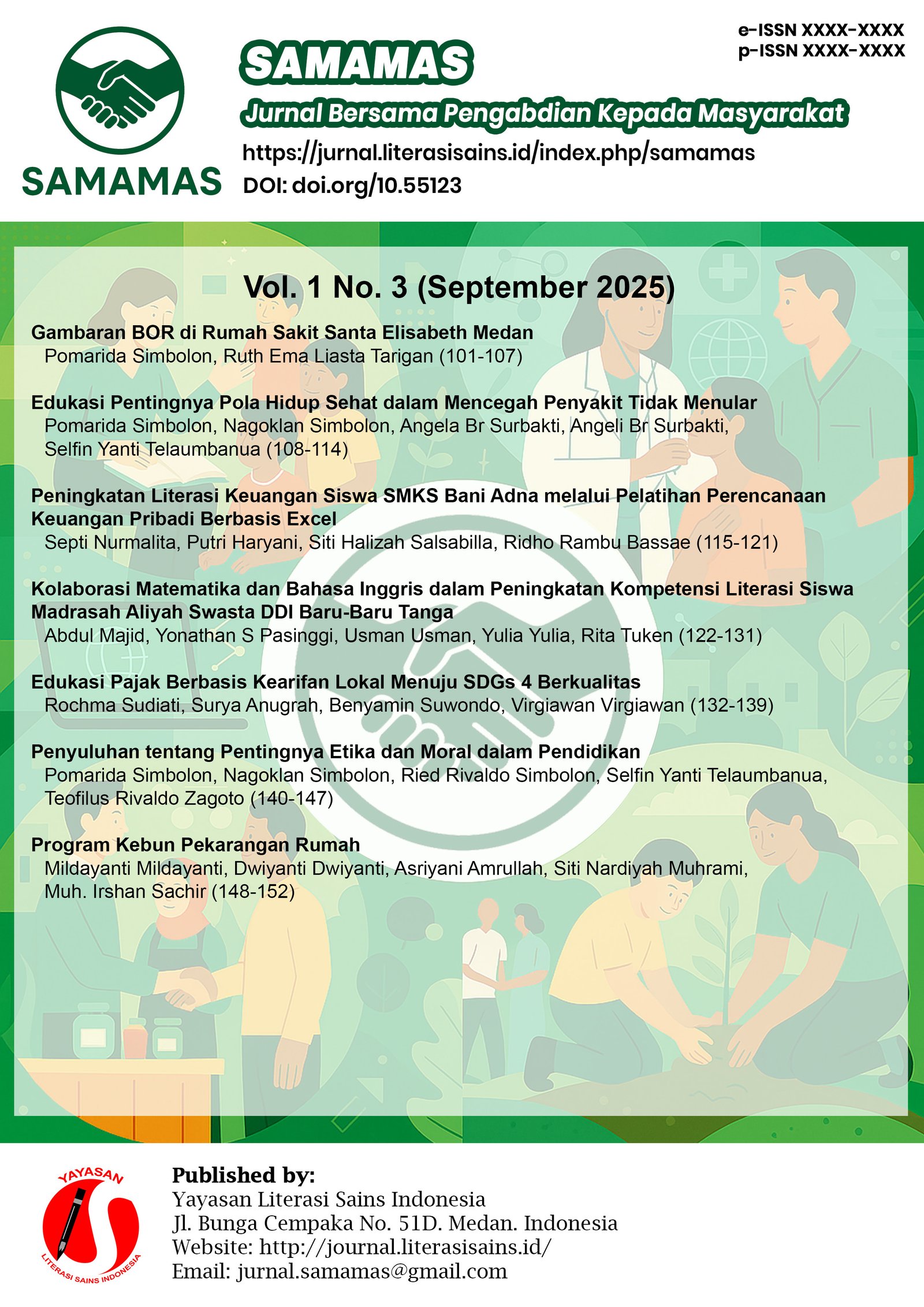
Edukasi Pajak Berbasis Kearifan Lokal Menuju SDGs 4 Berkualitas
DOI:
https://doi.org/10.55123/samamas.v1i3.317Keywords:
Tax Education , Local Wisdom , Digital Literacy , Vocational Students , SDGs 4Abstract
This community service program aims to improve vocational school students' understanding of taxation through education based on local wisdom integrated with digital literacy. This activity was carried out at SMK Negeri 11 Bekasi using an interactive training approach and digital taxation simulations such as e-Filing and e-Billing. The program also integrates local values such as mutual cooperation, social justice, and collective responsibility to provide a relevant social context regarding the importance of taxes. The evaluation results obtained from this activity show a significant positive impact on students' understanding. The role and support of SMK Negeri 11 Bekasi facilitated the smooth running of this activity. Additionally, there has been a positive change in students' attitudes and interest in the world of taxation, including career interest in this field. This approach supports the achievement of SDG 4 (quality education) through partnerships between universities, schools, and the community, and plays a role in creating a young generation that is tax-aware and digitally literate.
Downloads
References
Limilia, P., Gelgel, R. A., & Rahmiaji, L. R. (2022). Digital Literacy Among Z Generation in Indonesia. European Proceedings of Social and Behavioural Sciences, 1–11. https://doi.org/10.15405/epsbs.2022.01.02.1
Mil, S., Nurillah, D., & Yulia, C. (2025). Menciptakan Pembelajaran Menyenangkan dan Bermakna Untuk Anak Usia Dini Dengan Sentuhan Kearifan Lokal. Jurnal Pemberdayaan Masyarakat Universitas Al Azhar Indonesia, 7(2), 137. https://doi.org/10.36722/jpm.v7i2.4062
Nugraha, D. W. (2021). Pajak Menjadi Simbol Gotong Royong dan Keadilan. https://www.kompas.id/baca/ekonomi/2021/07/15/pajak-menjadi-simbol-gotong-royong-dan-keadilan
Otoritas Jasa Keuangan. (2022, Nopember). Siaran Pers Survei Nasional Literasi dan Inklusi Keuangan Tahun 2022. Ojk.Go.Id. https://ojk.go.id/id/berita-dan-kegiatan/siaran-pers/Pages/Survei-Nasional-Literasi-dan-Inklusi-Keuangan-Tahun-2022.aspx
Ramadhan, A. A., Maulidya, R., Salsabiila, P., Mu’afi, M. F., Widayati, E., & Nufaisa, N. (2024). Peningkatan Pemahaman Masyarakat Desa Sanganom dalam Pencegahan Stunting Melalui Edukasi Gizi Seimbang. Jurnal Pemberdayaan Masyarakat Universitas Al Azhar Indonesia, 7(1), 1. https://doi.org/10.36722/jpm.v7i1.3177
Rinaldi, M., Ariandi, M. A., Fitria, Y., & Ramadhani, M. A. (2024). Tax-Aware Generation: Membentuk Kesadaran Perpajakan Siswa SMK Melalui Pembelajaran Interaktif Berbasis Digital. Jurnal Pemberdayaan Ekonomi, 3(2), 65–75. https://doi.org/10.35912/jpe.v3i2.4427
Rusdi, W. E., Farindra, I., Masithah, D., Almah, B. A. N. R., Artyuga, A. H., Nuari, N., Rizkina, M. N., & Benge, W. D. M. R. (2024). Penyuluhan dan Pencegahan Infeksi Norovirus di Lingkungan Sekolah. Jurnal Pemberdayaan Masyarakat Universitas Al Azhar Indonesia, 6(3), 197. https://doi.org/10.36722/jpm.v6i3.3185
Salleh Cahayani Goma, Y. B. D., Mahendra, D. D., Jonathan, K., & Suryaatmaja, K. (2025). Assessing Digital Literacy’s Role in the Adoption of Core Tax Technology: Insights from Indonesia’s Tax System". Syntax Literate ; Jurnal Ilmiah Indonesia, 10(5). https://doi.org/10.36418/syntax-literate.v10i5.58695
Sari, T. B., Ningsih, A. P., & Sudirham, S. (2025). Edukasi Pentingnya Penerapan Perilaku Hidup Bersih dan Sehat (PHBS) pada Anak Sekolah Dasar GP Tombasian Atas. Jurnal Pemberdayaan Masyarakat Universitas Al Azhar Indonesia, 7(2), 129. https://doi.org/10.36722/jpm.v7i2.4054
The Impact of E-Billing, Tax Literacy, Tax Socialization, and Financial Information Quality on Self-assessment Effectiveness. (2022). In M. Kadafi, F. Rahman, & T. Safitri, Advances in Social Science, Education and Humanities Research (pp. 651–655). Atlantis Press SARL. https://doi.org/10.2991/978-2-494069-83-1_113
Triansyah, I., & Putra, R. R. (2025). Pengaruh Literasi Pajak Terhadap Kepatuhan Wajib Pajak Dengan Literasi Digital Sebagai Pemoderasi.
Wahyu, F. P., & Santosa, D. M. (n.d.). The Collaboration Between Educational Institutions and the Directorate General of Taxes in Enhancing Student Literacy on Tax Technology. 6(1).
Wardyaningrum, D., Zarkasi, I. R., Ripmiatin, E., & Jamal, A. (2025). Peningkatan Pengetahuan Warga di Wilayah Rawan Bencana Cianjur tentang Pembentukan Desa Persaudaraan (Sister Village). Jurnal Pemberdayaan Masyarakat Universitas Al Azhar Indonesia, 7(1), 71. https://doi.org/10.36722/jpm.v7i1.3762
Wulandari, D. S., & Dasman, S. (2023). Taxpayer Compliance: The Role of Taxation Digitalization System and Technology Acceptance Model (TAM) with Internet Understanding as a Mediating Variable. East Asian Journal of Multidisciplinary Research, 2(6), 2385–2396. https://doi.org/10.55927/eajmr.v2i6.4653
Zamzam, A., Hastjarjo, S., & Slamet, Y. (2023). Effectiveness Use of Tiktok Social Media @DitjenPajakRI Deployment Information Taxation. Journal of Social Interactions and Humanities, 2(1), 55–66. https://doi.org/10.55927/jsih.v2i1.3714
Downloads
Published
How to Cite
Issue
Section
License
Copyright (c) 2025 Jurnal Bersama Pengabdian Kepada Masyarakat (SAMAMAS)

This work is licensed under a Creative Commons Attribution-ShareAlike 4.0 International License.
Authors who publish with this journal agree to the following terms:
- Authors retain copyright and grant the journal right of first publication with the work simultaneously licensed under Creative Commons Attribution-ShareAlike 4.0 International License that allows others to share the work with an acknowledgment of the work's authorship and initial publication in this journal.
- Authors are able to enter into separate, additional contractual arrangements for the non-exclusive distribution of the journal's published version of the work (e.g., post it to an institutional repository or publish it in a book), with an acknowledgment of its initial publication in this journal.
- Authors are permitted and encouraged to post their work online (e.g., in institutional repositories or on their website) prior to and during the submission process, as it can lead to productive exchanges, as well as earlier and greater citation of published work (Refer to The Effect of Open Access).