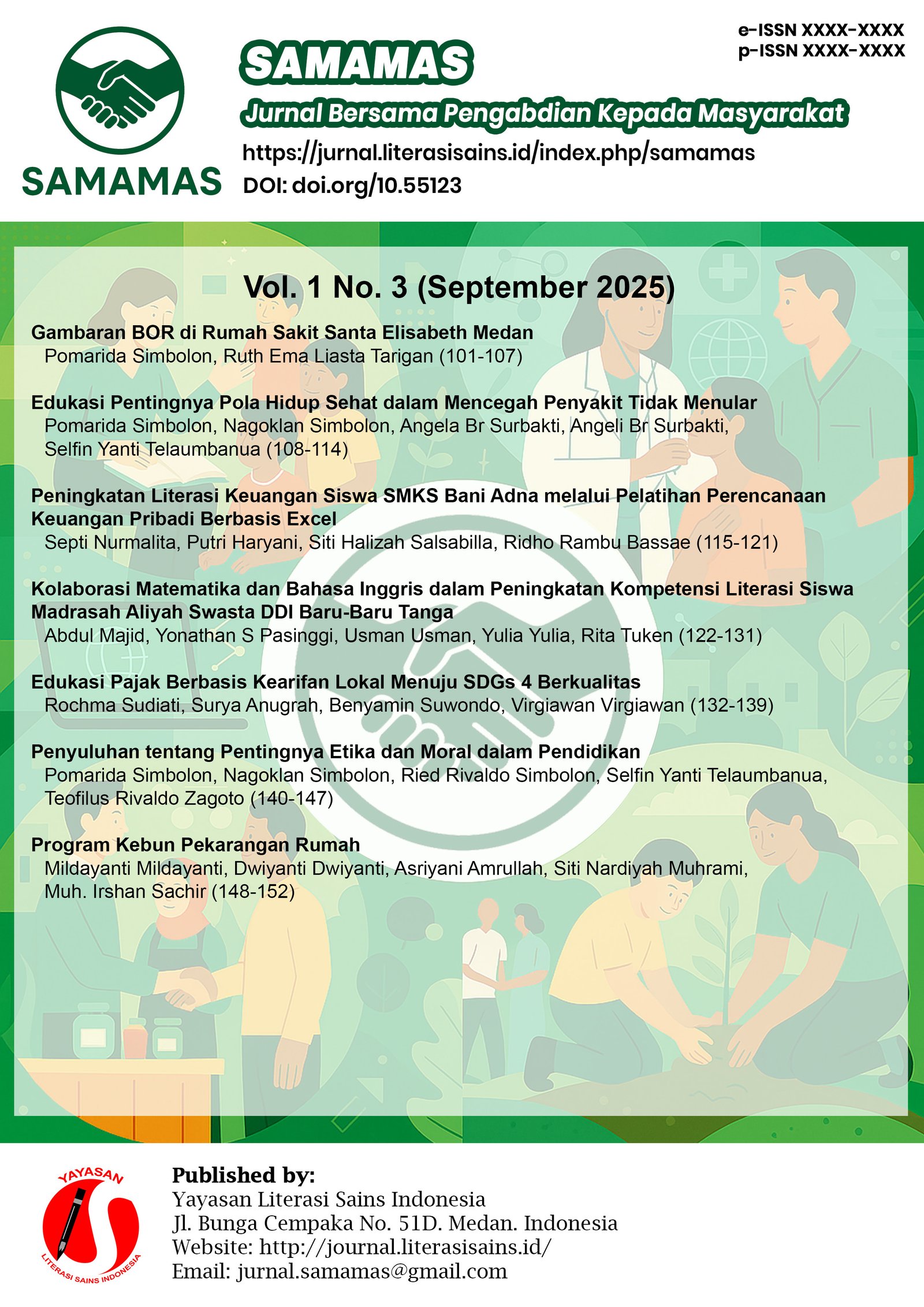
Peningkatan Literasi Keuangan Siswa SMKS Bani Adna melalui Pelatihan Perencanaan Keuangan Pribadi Berbasis Excel
DOI:
https://doi.org/10.55123/samamas.v1i3.311Keywords:
Financial Literacy , Training , Financial Planner , ExcelAbstract
The low level of financial literacy among Indonesian youth remains a serious challenge, particularly for vocational high school (SMK) students who are being prepared to enter the workforce. This community service program aims to enhance students’ financial literacy through personal financial planning training using Microsoft Excel, conducted at SMKS Bani Adna, Bojong Loa Village, Tangerang Regency. The method employed was a one-day workshop consisting of three stages: a Google Form–based pre-test, an interactive training session emphasizing fundamental concepts of personal financial management and budgeting practices using Excel, and a post-test to measure students’ improvement in understanding. The training results indicated a significant increase in students’ financial understanding, with the highest improvement of 10.26% observed in the aspect of daily expense recording. A total of 93% of participants found the Excel template easy to use, and 89% expressed interest in joining follow-up training sessions. This program demonstrates that a simple technology-based approach can effectively enhance students’ financial literacy while offering opportunities for replication in other schools through collaboration among universities, schools, and local communities.
Downloads
References
Anam, K., & Setyawan, S. (2023). Analisis Perilaku Manajemen Keuangan Generasi Milenial : Prespektif Literasi Keuangan, Literasi Ekonomi, Dan Kesadaran Digital. Jurnal Ilmiah Akuntansi 45, 4(1).
Indah Sayekti, P., & Etika Rahmawati, L. (2025). Penerapan Literasi Finansial pada Siswa Sekolah Dasar dan Dampaknya terhadap Keterampilan Berwiraswasta. Jurnal Kependidikan, 14. https://jurnaldidaktika.org
Khairunnisah, N. A., Alfarisi, Moh. S., Azim, 3Muhmmad, Supandi, & Sudiati. (2024). Pentingnya Literasi Keuangan dalam Manajemen Keuangan Pribadi. Journal of Public Sector Financial Management Journal of Public Sector Financial Management 7. https://jurnal.bisnislombok.ac.id/index.php/maci
Klapper, L., Lusardi, A., & Van Oudheusden, P. (2022). Financial Literacy Around the World: Insights from the Standard & Poor’s Global Financial Literacy Survey.
Lusardi, A., & Mitchell, O. S. (2014). The economic importance of financial literacy: Theory and evidence. American Economic Journal: Journal of Economic Literature, 52(1), 5–44.
Mittal, G. (2025). Financial Literacy and Retirement Planning in the Age of Digital Behavior and Socioeconomic Transformation. Journal of Social Commerce, 5(2), 157–172. https://doi.org/10.56209/jommerce.v5i2.136
OECD. (2022). International Network on Financial Education.
OJK. (2022). Survei Nasional Literasi Keuangan Tahun 2022. In https://ojk.go.id/id/kanal/edukasi-dan-perlindungan-konsumen/Pages/literasi-keuangan.aspx#:~:text=Literasi Keuangan adalah pengetahuan%2C keterampilan,untuk mencapai kesejahteraan keuangan masyarakat. https://ojk.go.id/id/berita-dan-kegiatan/siaran-pers/Pages/Survei-Nasional-Literasi-dan-Inklusi-Keuangan-Tahun-2022.aspx#:~:text=Siaran%20Pers%3A%20Survei%20Nasional%20Literasi%20dan%20Inklusi% 20Keuangan%20Tahun%202022,-22%20November%202022
Downloads
Published
How to Cite
Issue
Section
License
Copyright (c) 2025 Jurnal Bersama Pengabdian Kepada Masyarakat (SAMAMAS)

This work is licensed under a Creative Commons Attribution-ShareAlike 4.0 International License.
Authors who publish with this journal agree to the following terms:
- Authors retain copyright and grant the journal right of first publication with the work simultaneously licensed under Creative Commons Attribution-ShareAlike 4.0 International License that allows others to share the work with an acknowledgment of the work's authorship and initial publication in this journal.
- Authors are able to enter into separate, additional contractual arrangements for the non-exclusive distribution of the journal's published version of the work (e.g., post it to an institutional repository or publish it in a book), with an acknowledgment of its initial publication in this journal.
- Authors are permitted and encouraged to post their work online (e.g., in institutional repositories or on their website) prior to and during the submission process, as it can lead to productive exchanges, as well as earlier and greater citation of published work (Refer to The Effect of Open Access).